
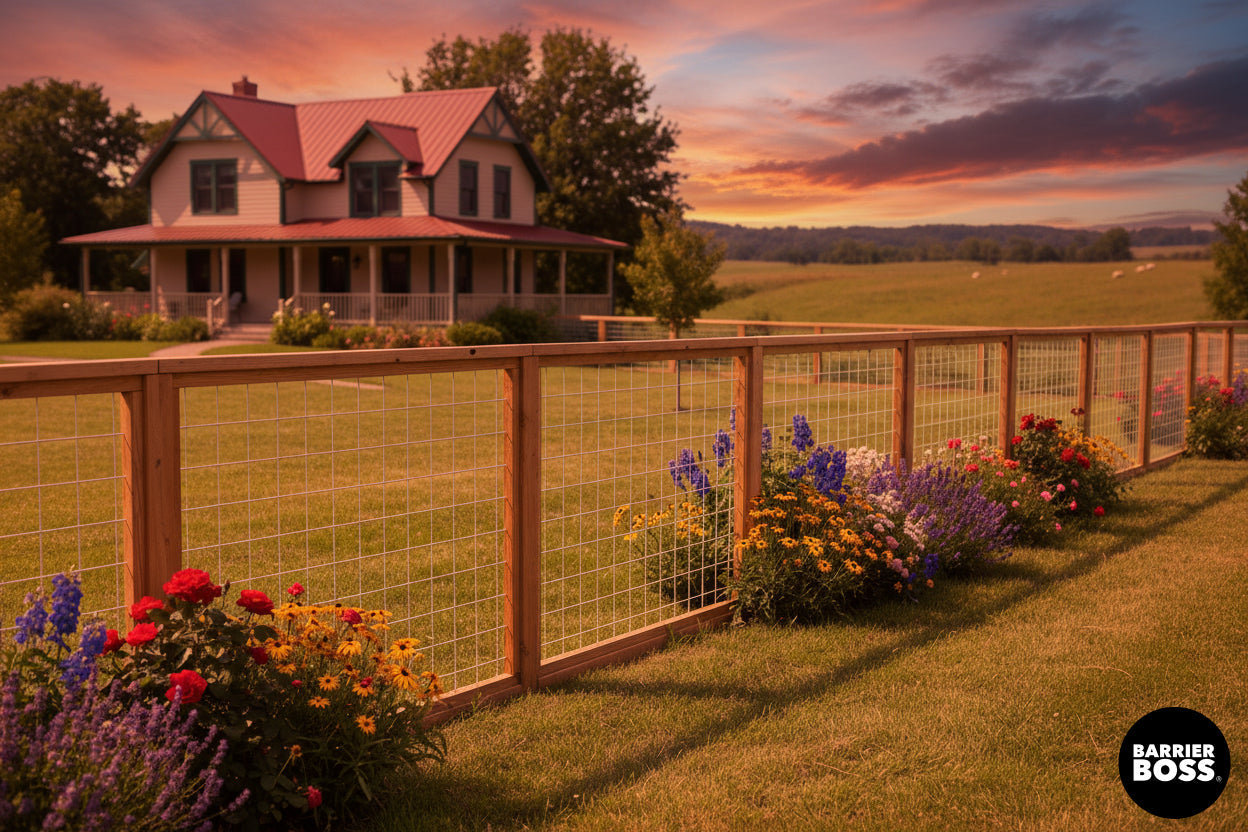
Premade Hog Wire Fence Panels vs. DIY: Which Is Right for You?

Premade Hog Wire Fence Panels vs DIY: Which Is Right for Your Yard?
Jump to:
- Premade Hog Wire Panels — What You Get
- DIY Hog Wire Fence — What's Involved
- Cost Comparison: Premade vs DIY
- Time to Install
- Quality & Durability Differences
- Security, Pets & Pool Safety
- When to Choose Premade vs DIY
- BarrierBoss Panel Specifications
- Frequently Asked Questions
Premade Hog Wire Panels — What You Get
BarrierBoss premade hog wire panels arrive at your property ready to install. Every panel is manufactured from 6-gauge hot-dip galvanized steel wire — significantly thicker than the 9- or 12-gauge wire used by most competitors — and finished with a durable fluidized dip-coat for colour and UV resistance.
When you order a premade panel, you receive:
- Pre-welded 6-gauge mesh with uniform openings (your choice of 1"×1", 2"×2", 2"×6", or 4"×4")
- Hot-dip galvanized + dip-coated finish — dual-layer corrosion protection that self-heals minor scratches
- Pre-framed option in Western Red Cedar or pressure-treated lumber (ready to install between posts)
- Exact dimensions — factory-cut to precise sizes from 3×6 to 8×8 feet, with custom sizing quoted on request
- Colour options — black, brown, silver, green, and rust patina
- 40-year warranty on materials and craftsmanship
The key advantage: consistency. Every panel looks identical to the next. The mesh spacing is uniform, the finish is even, and the frame (if you choose framed) is square and true. You cannot achieve this level of consistency building panels one at a time in a garage.
Best For:
- Homeowners who want professional results without the tools or skills
- Large projects where panel-to-panel consistency matters
- Anyone who values their weekends
- Properties where curb appeal and resale value are priorities
- Deck railing projects where code compliance requires precise mesh sizing
DIY Hog Wire Fence — What's Involved
A DIY hog wire fence means you purchase unframed mesh panels and build the wood frame yourself. This gives you full control over frame material, dimensions, and design — but it also means you take on the manufacturing responsibility.
A typical DIY build requires:
- Unframed hog wire mesh — available from BarrierBoss in standard sizes
- Lumber — 2×4 or 2×6 for top and bottom rails, 4×4 for posts
- Tools — miter saw, drill/driver, wire cutters or angle grinder, level, post hole digger, clamps
- Hardware — screws, staples or hog wire track kits for mounting mesh to the frame
- Concrete — fast-setting for post footings
- Time — significantly more than premade installation
Best For:
- Experienced DIYers with a workshop and the right tools
- Custom dimensions that don't fit standard panel sizes
- Tight budgets where labour cost is $0
- Projects where you want a specific wood species or stain colour
Cost Comparison: Premade vs DIY
The price gap between premade and DIY is smaller than most people expect once you factor in all the materials and tools needed for a DIY build.
| Item | Premade (per 6×8 panel) | DIY (per 6×8 section) |
|---|---|---|
| Hog wire mesh | Included | $50-80 (unframed panel) |
| Frame lumber | Included (cedar or PT) | $30-60 (2×4 + 2×6) |
| Hardware/fasteners | Included | $10-20 |
| Track kit or staples | N/A (factory-welded) | $15-30 |
| Post (4×4×8) | Sold separately | $15-25 |
| Concrete | You supply | $5-8 per post |
| Tools (if not owned) | Drill only | $200-400 one-time |
| Total per section | $180-350 | $125-225 + tools |
| Labour time | 20-30 min per panel | 1.5-3 hours per section |
For a 100-linear-foot fence (about 13 panels at 8ft width), the total difference is typically $700-1,600. That gap narrows or disappears if you value your time at any reasonable hourly rate, or if you need to buy tools.
Time to Install
Premade panels: Once posts are set, a single person can mount premade panels at a rate of about 2-3 panels per hour. A 100-foot fence takes one weekend — Saturday for posts (let concrete cure overnight), Sunday for panels.
DIY build: Building each frame, cutting mesh to fit, securing mesh to the frame, and then mounting takes 1.5-3 hours per section. The same 100-foot fence takes 2-3 full weekends, assuming no mistakes or re-cuts.
If you make an error on a premade panel, you install the next one. If you make an error on a DIY frame, you're rebuilding from lumber.
Quality & Durability Differences
Wire Quality
BarrierBoss premade panels use 6-gauge wire that is hot-dip galvanized and then dip-coated — a dual-layer corrosion barrier. The galvanization bonds metallurgically with the steel, and the dip-coat adds UV protection and colour. If the colour coat gets scratched, the galvanization underneath continues protecting the wire. Or, try out silver hog wire panels, galvanized without the coating.
DIY builders using the same BarrierBoss unframed panels get the same wire quality. The difference is in the frame and assembly.
Frame Quality
Factory-framed panels are assembled in a controlled environment with jigs that ensure square corners and consistent dimensions. Every panel is identical. DIY frames depend entirely on your skill level, tools, and workspace — slight variations in squareness, spacing, or staple placement are common even for experienced builders.
Lifespan
The wire mesh in both cases will last 20-30+ years (backed by BarrierBoss's 40-year warranty). The frame lifespan depends on the wood species: Western Red Cedar lasts 15-25 years naturally, pressure-treated lumber lasts 15-20 years with chemical protection. Both outlast a standard wood fence.
Security, Pets & Pool Safety
Mesh opening size matters for both premade and DIY — but premade panels guarantee the advertised opening size.
- Dogs: Use 2"×2" mesh for medium and large dogs, 1"×1" for small dogs. The mesh must be tight and uniform — sagging or stretched mesh from a bad DIY install creates escape gaps. Premade panels eliminate this risk.
- Pool fencing: Code requires 48" minimum height, maximum 4" openings between any vertical members, self-closing gates. Both 2"×2" and 4"×4" mesh meet the opening requirement. However, building inspectors may scrutinize DIY mesh attachment methods more closely than factory-welded panels.
- Livestock: 4"×4" mesh in 6-gauge wire resists body impacts from cattle, horses, and large dogs. The factory weld points on premade panels are stronger than stapled or screwed mesh-to-frame connections in DIY builds.
When to Choose Premade vs DIY
Choose Premade When:
- You want a finished fence in one weekend, not three
- Consistency between panels matters (visible from the street, HOA requirements)
- You're doing a deck railing where code compliance is non-negotiable
- You don't own a miter saw, wire cutters, or clamps
- The project is larger than 50 linear feet (time savings compound)
- You want the 40-year warranty to cover the complete panel, not just the wire
Choose DIY When:
- You need non-standard dimensions that aren't available as premade
- You're an experienced woodworker who enjoys the build
- Budget is the primary constraint and your labour is free
- You want a specific wood species or finish not offered in premade framing
- You're building a small project (single gate, garden trellis) where one panel isn't worth ordering
BarrierBoss Panel Specifications
| Spec | Detail |
|---|---|
| Wire gauge | 6-gauge (0.162" / 4.11mm diameter) |
| Wire coating | Hot-dip galvanized + fluidized dip-coat (dual-layer) |
| Mesh openings | 1"×1", 2"×2", 2"×6", 4"×4" |
| Panel sizes | 3×6 to 8×8 feet (custom sizes available) |
| Max height | 8 feet — the only manufacturer offering this size |
| Colours | Black, brown, silver, green, rust patina |
| Frame options | Western Red Cedar, pressure-treated lumber, or unframed |
| Warranty | 40 years on materials and craftsmanship |
| Delivery | BarrierDirect — our own trucks, complimentary unloading |
Frequently Asked Questions
Can I mix premade and DIY in the same fence?
Yes. Many customers use premade panels for the visible sections (front yard, street-facing) and DIY for utility areas (back corners, garden enclosures) where aesthetics matter less. As long as you use the same mesh opening and colour, the wire will match. The frame may look slightly different depending on your woodworking skill.
Are premade panels harder to transport than unframed mesh?
Premade panels are larger and heavier because they include the wood frame. BarrierBoss delivers on our own BarrierDirect truck fleet with complimentary unloading — so you don't need to figure out how to fit 6×8 panels in your pickup truck. Unframed mesh rolls or folds for easier self-transport if needed.
Do premade panels cost more per square foot?
Yes — typically 30-50% more than buying unframed mesh and lumber separately. But this includes factory-quality framing, guaranteed square corners, and the 40-year warranty on the complete assembly. The total cost of a DIY build often approaches premade pricing once you add lumber, hardware, tools, and a realistic value on your time.
Can I get custom sizes in premade panels?
Yes. BarrierBoss manufactures panels in standard sizes from 3×6 to 8×8 feet and offers custom dimensions on request. Contact us with your specifications for a quote.
What if my yard has a slope?
Both premade and DIY panels can be installed on slopes using either the racking method (angling panels to follow the grade) or the stepped method (stair-stepping level panels). Unframed mesh is slightly easier to rack since it can flex within a frame you build on-site. Premade framed panels work best with the stepped method on moderate slopes.